Black Hole Cosmos |  |
Black Hole Cosmos | |
A (stellar) black hole is formed when a very massive star, in whose center the last possible nuclear fusion has ceased, explodes in a supernova and leaves a stellar remnant in the center, which still has more than two and a half solar masses (m0=5·1030kg). This remnant star then collapses to form a black hole. A black hole with less mass than m0 cannot be formed in this way.The physical processes that take place in a core-collapse supernova are theoretically well calculated and the results of the calculations agree with corresponding observations, for example, of the supernova SN1987A. Dark matter and dark energy are not taken into account in the calculations, The same applies to the following considerations. If one believes the theoretical models, then all the mass of a black hole disappears in a point-like (Schwarzschild metric) or ring-like (Kerr metric) singularity. Since both singularities have no volume, the mass density there is infinite. Given such an unphysical result, one can doubt whether the theory is applicable to the interior of a black hole, and instead apply the simple equations for the relationships between a mass M, its volume V, and the average mass density ρ. For a black hole, the same relationship between the (Schwarzschild) radius R and the volume V applies as for a sphere in Euclidean geometry.
| (1) | |||||||||||||||||||||||||||||||||||||||||||||||||||||||
| (2) | |||||||||||||||||||||||||||||||||||||||||||||||||||||||
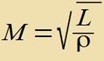
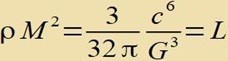
As long as the product ρ·M² remains smaller than the constant L, the mass M and its density ρ can assume arbitrary values independently of each other. However, if in a fixed volume the mass increases so much that ρ·M² becomes equal to L, then a black hole is created, and due to the relationship ρ·M²=L, ρ and M are now inseparably connected. If the mass M of the black hole increases, the volume V becomes larger and the density ρ decreases according to equation (1c). Because no mass can escape from the black hole and, according to equation (1c), ρ is inversely proportional to M², the density ρ cannot become larger. The constant L is an upper limit for the product ρ·M². It follows:
| (A) (B) M0=1053kg is the estimated mass of the observable universe, and according to Theorem A, the maximum possible density of this mass is ρmax=L/M²≅10-26kg/m³. The estimated mass density of the observable universe is ρ0=10-26kg/m³, it is therefore equal, or nearly equal, to the maximum possible density of the mass of the universe. As the universe expands, its density continuously decreases. From the redshift z of a distant galaxy, one can determine the scale factor a = 1/(1+z) and, consequently, the change in density relative to the present day. JADES-GHS-z14-0 is a very early galaxy with a redshift of z=14. At the time JADES emitted this light, the mass density of the universe was (1+z)³= 3375 times greater than it is today. This density far exceeds the maximum possible mass density of the mass M0=1053kg. At a density of ρ14=3375·ρ0, the maximum possible mass, according to theorem (B), is M14=⎷(L/ρ14)=M0/⎷3375=1,7·1051kg. If (A) and (B) hold true, then the mass of the universe has increased significantly over the course of its expansion.
(3)
(4) (5) (6)
|
 
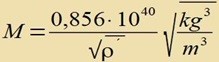
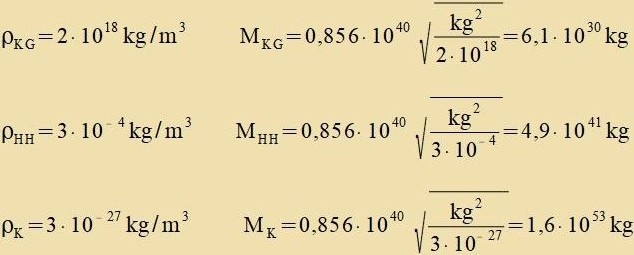
(7) (8) MKG and RKG correspond to the values of the smallest stellar black hole discovered so far. A significantly smaller one is hardly possible. At 5700K, the H-He plasma in the photosphere of the Sun has the density ρHH. When the recombination era of the cosmos begins the density is nearly ρHH. The mass MK differs hardly at all from the estimated (visible) mass of the universe (Wikipedia: ≈ 1053 kg). For the radius of the universe, AI gives 46 billion light-years. That is 4.4·1026 m, i.e. about twice RK. That the estimated data for the mass M, the average density ρ, and the radius R of the universe fit the picture of a black hole could be a strange coincidence. Nevertheless, it is a strong indication for the black-hole universe. Instead of believing in a Big Bang, in which all mass and energy appeared out of nothing in 10-4s, contrary to all conservation laws of physics, it is assumed here that the origin of our universe was a stellar black hole within a larger universe. This black hole could have had a mass of about MKG (20% more than m0), thus being at the lower limit of the mass and the upper limit of the density of a stellar black hole. After its formation, the black-hole cosmos continuously absorbs more or less mass from the surrounding universe. The temporal evolution of the cosmos proceeds from a quark-gluon phase through the same states that are also assumed in the Big Bang theory, but it is not determined by an extrapolated Hubble time; rather, it depends on the irregular absorption of masses from the encompassing universe. According to equations (1), this is associated with an increase in volume and a decrease in density. The cosmos expands, the waves of electromagnetic radiation, which in the early cosmos constitute the main part of the energy and mass, are stretched apart, so that the radiation loses energy. Since radiation and mass are still in thermal equilibrium, the temperature of the cosmos decreases. At 5700 K, the mass of the cosmos has grown to half a trillion solar masses (Eq. 5) and the radius to one tenth of a light-year (Eq. 8b). The cosmos absorbs more mass, the density becomes lower, the expansion continues, and the temperature falls until, at about 3000 K, matter and radiation decouple. The mass of the cosmos now consists of neutral atoms, and the radiation survives as background radiation, undisturbed but constantly becoming longer-wavelength, for billions of years. The measurement of the background radiation provides the earliest experimental result of all, while for the time before it there are only purely theoretical considerations. With z=1100, its redshift is greater than that of any other event in the cosmos.
When the cosmos as a black hole in the universe takes in new mass, the horizon expands and the mass density decreases. The gravitational forces of the masses of the surrounding universe and the centrifugal force of the cosmos, which rotates like every black hole, fill the space between the old and the new horizon. The cosmos continues to inflate and the distances between the galaxies increase. Since the surface also grows with every intake of mass, the probability of further mass intake increases, and the expansion accelerates. With one hundred billion solar masses already at the beginning of the recombination era (Eq. 5, 8b), the de-Sitter-Cosmos, as a black hole, is by far large enough to absorb black holes with several tens of thousands of solar masses from the surrounding universe. In a hydrogen-rich environment, they then grow into the supermassive black holes that appear as very early AGNs of early galaxies. Comparison between the Big Bang theory and the Black-Hole-Cosmos (BHC)
A
| e-mail: dh8dm@gmv.de
| |||||||||||||||||||||||||||||||||||||||||||||||||||||


 .